

A blog for the coffee lovers
Welcome to the PureBean Blog. Stay updated with our latest news & information.

How Workplace Coffee Keeps Staff Happy and Productive
How Coffee Keeps Your Workplace Running (And Your Team Happier)
| Good coffee can lift energy and focus across the whole office. See how coffee in the workplace supports productivity, and explore beans and machine options. Get a quote today. |

In Short
- Coffee in the office can be a frequent, tangible signal of investment in daily working life, a key factor in helping employees feel cared for.
- A well-equipped and frequently used tearoom creates social opportunities for informal conversation across teams, particularly in hybrid workplaces where unplanned contact has thinned out.
- Good workplace coffee supports routine, convenience and short resets between tasks, rather than solving productivity on its own.
- A coffee machine only adds value when it is reliable, easy to use and consistently stocked with beans, milk and cleaning supplies.
- Workplace coffee works best as part of a broader tearoom setup that accommodates different preferences and dietary needs.
How does coffee affect the workplace?
Coffee affects the workplace less through caffeine alone and more through the repeated culture, routine and interaction built around it. The distance and separation of your walk to the machine from your work desk, the minute spent waiting, conversations with your team that populates your brew time: these are small moments that shape how perspectives and associations to your workplace by staff are built, brick by brick, each day.
How can coffee breaks support work rhythms?
A coffee break gives staff a social pardon to step away from screens, meetings or concentrated work for a few minutes. The walk to the tearoom is everyone’s go-to excuse for a quick reset, and nobody’s going to judge you for the coffee (or three) that gets you through the day.
This momentary, taken-for-granted departure from the desk is a prelude to this, behaviourally pre-empting and conditioning the mind to expect focus for the rest of the day.
Safe Work Australia’s psychosocial hazard framework recognises that poor support and isolated work can contribute to psychological harm, adding to this. Small moments of movement and connection don’t replace good management, but they can indirectly support healthier workplace rhythms in conjunction with it.
Why is the tearoom important for workplace connection?
Tearooms create one of the few dependable places for casual, low-pressure interaction, especially in hybrid workplaces where spontaneous contact has thinned out in comparison to its predecessor generation of workers.
- A project issue raised while waiting for coffee can be given exposition faster than one buried in an email thread.
- Colleagues from different teams start recognising each other outside the boundaries of scheduled meetings or work processes.
- Newer staff pick up how the workplace operates, and find opportunities for self-inserts through casual conversation that doesn’t happen over emails and Slack messages.
These interactions don’t directly cause retention, but they are part of the everyday conditions that make a workplace feel connected rather than transactional.
Why does good coffee feel like a meaningful workplace perk?
Staff notice the difference between instant coffee sitting in a cupboard and a quality machine with fresh beans, milk and the sense of your coffee station being a curated choice. The gap between these two scenarios can be large in the signal it sends about how the employer values your daily experience.
As evidenced from a 2024 meta-analysis on the relationship between ‘perceived organisational support’ and employee satisfaction, the interaction between investment in workplace benefits and working attitude is hugely influential on team morale and personal happiness.
Although one feature in one archetype of workplace benefits, keeping your office coffee at a great quality and readily available for staff can only improve the amenities employees rely on to stay satisfied and equipped to handle their work needs.
Costs and Daily Savings With An Office Coffee Supply
Commonwealth Bank reported in January 2026 that flat white prices had risen roughly 30 per cent since the pandemic, reaching about $6.50 in Sydney and Perth and around 50 cents less in most other capital cities.
As an illustration, one café coffee each working day at those prices comes to roughly $30 a week and comfortably more than $1,000 across a working year. That makes reliable workplace coffee a tangible convenience benefit for staff, not a grand retention promise, but a practical saving they experience every single day.
How does PureBean make workplace coffee more reliable?
PureBean is an Australian owned coffee machine rental and servicing company that has supported workplaces and venues since 2004, with local service teams operating in every major city.
As a core principle, we’re there for you for what happens after installation; our priority is in how your coffee set up serves you for the entirety of its lifespan, from ongoing preventative servicing to replacement support, and not just on initial installation!
- This means proactive servicing and maintenance carried out during regular coffee supply deliveries, so issues are caught before the office notices them. PureBean operates as a coffee partner responsible for the overall experience, not simply a machine supplier that drops off equipment and moves on.
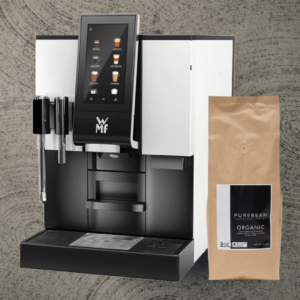
Our machine recommendations are based on workplace size, daily demand, staff preferences and the physical environment of the tearoom. The coffee machine range spans compact automatic machines for lower-volume offices, higher-capacity systems for busy sites, and group machines for large workplaces or venues. Brands across the range include WMF, Dr. Coffee, Rocket, Synesso and La Marzocco. Barista training is included for group machines, alongside six specialty bean blends, cleaning products and support for repairs or replacement where required.
The practical value lies in a coffee setup that remains consistently usable well beyond the first few months of enthusiasm.
Taking Care of Your Staff With a Wider Tea Room Supply
A coffee machine is only as usable as the milk beside it, and a tearoom stocking dairy, plant-based and lactose-free options works for the whole team. A tearoom that only functions at morning coffee time is a missed opportunity for the rest of the working day.
The Fruit Box Group is an Australian owned office tearoom delivery service that has supplied workplaces for more than 25 years across every major Australian city. Its service covers fresh office fruit delivery for accessible shared snacks throughout the day, milk delivery supporting different dietary preferences across the team, and office pantry supplies that keep commonly used tearoom essentials stocked without adding to anyone’s task list. Ordering is flexible with no lock-in contracts, and free delivery runs to multiple sites, floors and departments.
If you’re keen to explore how your workplace can benefit from holistic office refreshment and tearoom management, reach out to the team at The Fruit Box Group for more on how they can help.
Why does staff retention come down to everyday experience?
Retention is shaped by pay, leadership, workload and culture, and those factors form the foundation of whether people stay or leave. But daily conditions are where staff feel whether those commitments are real or just talking points in an all-hands meeting.
The commercial costs for businesses can be large enough to warrant close attention; at the end of the day, your staff are core assets of the business that action and operate every aspect of the day to day. Industry estimates cited by the Australian HR Institute commonly place the cost of replacing an employee between 50-150% of annual salary once recruitment, onboarding and the productivity ramp are counted, rising further for specialist and senior roles.
Why Should Businesses Care About Retaining Staff?
ABS data shows that job mobility in Australia has been declining over the long term (7.2% as of February, 2026), a trend stretching back decades. When fewer people move between employers, capable replacement hires become harder to find, which makes losing good staff much more costly, ahead of an increasingly turbulent economic climate on the horizon.
Of course, coffee shouldn’t be considered a retention strategy by itself (imagine workers predicating their employment on whether their office brew was good or not!), but having supportive, quality amenities is, and is one of the simplest daily signals that an employer can consider to make work life that much more enjoyable.
Why do workplace coffee setups stop being used?
Workplace coffee only contributes to culture when the setup works consistently without creating extra admin for the people managing it. Common failures, in this case, include:
- Machines selected for average use rather than peak morning demand, leading to queues and frustration.
- Equipment that staff haven’t been shown how to use properly, leading to inconsistent results and discouraging repeat use.
- Breakdowns that sit unresolved for days because servicing is reactive or escalation is unclear.
- No dairy-free, plant-based or lactose-free milk options for staff who need them.
- Beans, cleaning supplies or milk running out because reordering depends on one already busy office manager.
Once coffee becomes another recurring task to manage rather than a benefit people appreciate, it stops feeling like a workplace investment and starts feeling like a problem nobody owns.
If you’re ready to explore a setup suited to your team’s size and environment, get in touch for a no-obligation conversation.
Frequently Asked Questions
Does providing coffee at work actually improve staff retention?
Coffee alone does not improve staff retention in any direct or measurable way. Retention is driven by leadership, pay, workload, career opportunities and workplace culture as broader forces. Good coffee is a frequent, practical signal that contributes to the daily workplace experience when those larger foundations are already in place.
How much does an office coffee machine cost to run?
The running cost depends on the machine type, expected daily demand and the service arrangement in place. Typical cost components include machine rental or purchase, beans, milk, cleaning products, and servicing or repair arrangements over time. Check what’s included in any agreement, particularly around call-outs, preventative maintenance and the delivery of supplies.
How does coffee affect productivity?
Coffee can support focus and useful breaks throughout the day, but it doesn’t solve productivity problems on its own. The practical workplace benefit often comes from convenient access, a short reset between tasks and fewer reasons for staff to leave the office mid-morning. Workload, sleep, systems, management and work design remain more important productivity factors by a considerable margin.
What else should a workplace tearoom have besides coffee?
A useful workplace tearoom should cater for more than just the coffee drinkers on the team. A considered mix of milk options, fresh fruit, pantry basics, tea and non-caffeinated alternatives covers a wider range of preferences across different dietary needs. Choice and reliable stock levels matter more than an elaborate or expensive setup.